Primeval History (Genesis 1-11): Six Days of Creation?


    Now that we’ve gone through the entire primeval history from the garden of Eden onward, it’s time to take a look at the most difficult passage to interpret, the Genesis 1 creation account. If taken as a literal account of material origins, it says that the time from the creation of the universe to the first human beings was six 24-hour days. This even seems to be supported by Exodus 20:11, which uses the 6-1 day structure of the creation account as the basis for the Sabbath. But if that’s true, it means all the findings of modern science are wrong, requiring many more miracles than what’s described in the biblical account [1], and even undermining the accuracy of the rest of the primeval history (Gen. 2-11), which is supported by modern science (see the earlier posts in this series). So is this creation account just wrong, or is there a better way to interpret it?

    Note: This post is largely a summary of the argument in Old Testament scholar John Walton’s book The Lost World of Genesis One: Ancient Cosmology and the Origins Debate. I’ve removed a lot of details from his argument for brevity, and added a few where I felt it was important. But all credit regarding the argument in this post goes to him.

    Functional vs. Material Creation

Looking at this text from our modern, scientific worldview, which views the material world as most important, it seems to be describing the material origins of the universe, i.e., how God brought everything into being. However, this materialistic worldview which elevates physical being to a position of primary importance hasn’t always been around. In the ancient Near East, the function of a thing was considered to be most significant, and most in need of an explanation, rather than the material existence of that thing. [2]

    For example, the Insinger Papyrus from Egypt includes its own creation account, which describes the creation of all things but doesn’t deal with their material origins. Rather, it tells us what is the purpose of each of the created things. [3] The same is true of the Egyptian Instruction of Merikare, which includes a hymn to the creator god Atum (130-135). [4] The Akkadian creation myth KAR 4 tells us that heaven was created as an abode for the gods, that the earth was created to make the ground firm, and that the Tigris and Euphrates were made to properly place canals and ditches, but it doesn’t say anything about how these were materially formed. [5] The Babylonian Enuma Elish and Sumerian Debate Between Summer and Winter have the same emphasis on functionality (but not materiality). [6]

    This isn’t just true of extra-biblical texts from the ancient Near East, but even other biblical texts, such as the creation account in Psalm 104. This poetic description of creation begins by telling us that God created light for his glory (vv. 1-2; cf. Gen. 1:3-5) and heaven as his abode (vv. 2-4; cf. Gen. 1:6-8). The earth was founded so that the ground might not be shaken, and the waters went to their appointed places to provide a drink for the animals (vv. 5-13; cf. Gen. 1:9-10). Plants were created to give food for animals and people, the trees were made as a home for the birds (vv. 14-18; cf. Gen. 1:11-13). The heavenly lights were made to mark time for animals and people (vv. 19-23; cf. Gen. 1:14-19). All these things are given by God to the creatures of the land and sea (vv. 24-30; cf. Gen. 1:20-25). This psalm is clearly a parallel description of the Genesis 1 account (it’s even in the same order!), but it’s concerned only with functional purpose, not material origins. [7]

    Those who hold to a ‘material origins’ view of Genesis 1 (whether young-earth creationists, gap theorists, or old-earth creationists) may object that this interpretation abandons a ‘literal’ reading of the account. That I’m being inconsistent by interpreting Gen. 1 figuratively while interpreting the rest of the primeval history literally. However, this objection equivocates between ‘literal’ and ‘scientific’ or material; just because I don’t think Genesis 1 is a scientific account of origins doesn’t mean I’m not interpreting it literally within its cultural context. Furthermore, as we’ll see, there are indications within the creation account itself and the rest of the Hebrew Bible that it takes a functional view of origins.

    “Formless and Void”

The first thing the biblical author tells us, after the fact that “God created the heavens and the earth,” is that “the earth was formless and void” (Heb: tohu w’bohu). What does this mean? The Hebrew words tohu and bohu are only found a little over a dozen other times in the Old Testament, so let’s see how they’re used elsewhere:

The desert wilderness in which Israel spent 40 years was tohu (Deut. 32:10)

The Israelites should not turn from God to things that are tohu (1 Sam. 12:21)

The paths of caravans go to tohu and they perish (Job 6:18)

The north is stretched out over tohu, and the earth over nothing (Job 26:7)

God causes princes to wander tohu where there is no way (Ps. 107:40)

Jerusalem under siege is a city of tohu (Isa. 24:10)

The wicked turn aside the righteous for tohu (Isa. 29:21)

Edom will be destroyed and become a wilderness, tohu and bohu (Isa. 34:11)

The nations and their rulers are tohu to God (Isa. 40:17, 23)

The works of idolaters are in vain and their idols are tohu (Isa. 41:29)

Those who make idols are tohu (Isa. 44:9)

God did not create the earth tohu but to be inhabited (Isa. 45:18)

God did not ask Israel to seek him in tohu or the land of darkness (Isa. 45:19)

God’s servant has labored and spent his strength for tohu (Isa. 49:4)

The wicked rely on tohu when unjustly accusing the righteous (Isa. 59:4)

The land of Israel is tohu and bohu during the Babylonian exile (Jer. 4:23)

In every other instance throughout the Hebrew Bible, tohu and bohu do not refer to material non-existence or formlessness, but rather purposelessness or vanity. The only possible exception is Job 26:7, where the north is stretched out over tohu; however, this most likely refers to the waters of chaos that existed under the earth in ancient Near Eastern cosmology (Exod. 20:4; Ps. 24:1f; 136:6; cf. Enuma Elish 1.3-5; 4.128-140). [8]

    The two most notable uses of tohu and bohu are in Isaiah 45:18 and Jeremiah 4:23. Isaiah tells us that God “did not create [the earth] tohu, he formed it to be inhabited!” The opposite of tohu is not “existent” or “formed,” but “inhabited,” showing that tohu isn’t about material formlessness but whether something is functioning according to its God-given purpose. Likewise, Jeremiah clearly echoes the Genesis creation account by saying, “I looked on the earth, and it was tohu and bohu.” But this is in the context of a prophecy about the Babylonian siege of Jerusalem and exile (Jer. 4:5-27). The land of Israel didn’t cease to exist materially at this time, but it ceased to function according to its God-given purpose as a home for the Israelites.

    The Days of Creation

Based on the meaning of tohu and bohu, the Genesis creation account starts from a place of functionlessness, rather than a place of total material non-existence or formlessness. But what about the days of creation themselves? If we go through the actual creation story without reading any modern assumptions into it, the first three days of creation involve only the creation of functions and no actual material creation. The fourth through sixth days are less straightforward, but still emphasize function over material.

    On day 1 of creation, God “said, ‘Let there be light,’ and there was light.” God then separated the light from darkness, and named the light “Day” and the darkness “Night” (Gen. 1:3-5). The original readers of this text would have had no concept of light as a material object (photons), so there is no material creation on this day, just separation and naming.

    On day 2 of creation, God separates the cosmic waters into two by making a raqia (“firmament”), and names the raqia “Heaven” (Gen. 1:6-8; cf. Enuma Elish 4.128-140). If the raqia is a physical dome, as the original readers likely would have believed, then we now know such a dome doesn’t exist, so there is no material creation on this day. If the raqia is simply an “expanse,” as in some translations, then an “expanse” is not material so there is also no material creation, only separation and naming.

    On day 3 of creation, the waters below are gathered together and the land appears, and God names the waters “Sea” and the land “Earth” (Gen. 1:9-10). God assigns the land to bring forth plants (Gen. 1:11-13). As the dry land simply “appears” from beneath the waters, there is once again no material creation, only separation and naming, as well as assigning a function (to the land to bring forth plants).

    There’s nothing in the first three days that could be interpreted as material creation ex nihilo. This is surely significant, for if Genesis 1 were intended to give an account of material origins, it would tell us how these things were made. Instead, it emphasizes the assignment of these things to their proper place and function, and God naming them. The same emphasis is found in other ancient Near Eastern creation stories, such as the Enuma Elish, which tells us that nothing had a name before creation, not even the gods (1.1-8).

    On day 4 of creation, we’re told for the first time that God “made” (asah) something that could be material, the sun, moon, and stars (Gen. 1:14-19). This could be interpreted as either material or functional creation. The verb asah simply refers to the completion of a task, which could be material creation or assignment of function. [9] For example, in Exodus 20:9-10, it is used to describe people “doing” work, which obviously doesn’t involve material creation ex nihilo. Overall, the emphasis in this passage is on the function of the heavenly bodies – to give light, to separate day and night, and to separate light from darkness. Therefore, on the fourth day of creation, God assigned functions to the heavenly bodies.

    On day 5 of creation, God “created” (bara’) the tanninim (“sea monsters”) and other creatures of the sea and sky (Gen. 1:20-23). Like asah, the verb bara’ is ambiguous, and often refers to the assignment of function. [10] The overall emphasis in this passage is on the function of these creatures – to multiply and fill the sea and sky. Moreover, the tanninim were seen as creatures of chaos, so this is saying that even they have a function in God’s ordered creation. The same point about sea monsters is made elsewhere in the Hebrew Bible (Ps. 148:7; Isa. 27:1; 43:20; 51:9; cf. Job 41).

    On day 6 of creation, God “made” (asah) and “created” (bara’) the land animals and humans. Once again, the emphasis is on the function of humanity, which is the climax of the creation account and the most important function. All the rest of creation functions in relation to humanity, as we are meant to spread over the earth, to have dominion over the animals, and to eat the green plants (Gen. 1:26-30).

    In summary, the entire Genesis 1 account deals with the assignment of things to their proper place and function, rather than telling us how they were materially created, much like other ancient Near Eastern creation stories. Throughout the creation account, God sees that “it was good,” which means that it is functioning according to its assigned purpose (cf. Gen. 2:18). The closest it gets to describing material origins is when God commands the earth to bring forth plants, and the sea and land to bring forth life (Gen. 1:11, 20, 24). But this doesn’t mean that plants or animals are made out of dirt, or that sea creatures are made out of water, it just means that’s where they come from. (See the Sumerian epic The Exploits of Ninurta [390-410] for a similar statement.)

    The Seventh Day

Finally, on day 7 of creation, God “rested from all the work he had done” (Gen. 2:2f). Elsewhere in the Hebrew Bible, we’re told that God’s “resting place” is his temple (1 Chron. 28:2; Ps. 132:8, 13f; Isa. 66:1), which in a broad sense encompasses his entire creation (Isa. 66:1). The Babylonian creation story, Enuma Elish, also ends with the gods creating a temple that “shall be a dwelling for our rest at night; come, let us repose within!” (6.51-54) The idea that the cosmos is also the temple of God/the gods can be found all throughout ancient Near Eastern texts. [11]

    This helps to explain why Genesis 1 fits the creation of the cosmos into a seven-day framework. In the ancient Near East, the ceremony for the dedication of a temple lasted multiple days (usually seven), during which time the powers of the temple were declared and the roles of temple functionaries were declared. This is seen in over forty texts that describe temple dedication ceremonies. [12] The dedication of Yahweh’s temple and consecration of his priests in the Bible also lasted for seven days (Exod. 29:37; Lev. 8:31-36; 1 Kgs. 8:65; 2 Chron. 29:17; Ezra 6:22?). Importantly, the material creation of the temple always takes place before its dedication (and takes much longer than seven days).

    Therefore, the most likely explanation of the seven-day framework in Genesis 1 is that it’s meant to be the seven-day dedication ceremony of God’s cosmic temple, in which the proper place and function of the temple is first assigned (1:3-13), its functionaries – i.e., the heavenly bodies, animals, and humans – are designated (1:14-31), and finally God himself takes his place in the temple (2:1-3).

    Conclusion

If we look at the Genesis creation story from a modern, materialistic worldview, it seems to contradict the findings of modern science about the age of the cosmos and evolution of life on earth. But when we look at it using an ancient Near Eastern lens, as emphasizing functional purpose over material origins, there’s no contradiction. The story begins with a functionless (tohu w’bohu) heaven and earth, which over a seven-day dedication period is transformed into God’s own temple. The six days of creation may have been 24-hour days, or epochs, or even instantaneous (as some early Christians believed); this makes no difference. As Genesis 1 deals with the function of creation, while science deals only with empirical evidence and material origins, there can be no contradiction between the two.


______________________________

[1] Among other things, it would mean that God sped up radioactive decay by a factor of millions and miraculously removed the heat from this process, that he created the genomes of all organisms to look like they descended from a common ancestor, that he intervened to increase the genetic diversity of humans to make it look like our genetic common ancestor lived much more than 6,000 years ago… this list could go on for hours.

[2] John Walton, The Lost World of Genesis One: Ancient Cosmology and the Origins Debate (Downers Grove, IL: InterVarsity Press, 2009), 21-35.

[3] John Walton, The Lost World of Genesis One, 30-31.

[4] See a translation of this text here.

[5] See a translation of this text here.

[6] John Walton, The Lost World of Genesis One, 31-33.

[7] The psalmist’s creation account also indicates that animals like “donkeys,” “cattle,” “storks,” “wild goats,” “young lions,” and even “people” existed materially as early as days 3 and 4 of the Genesis creation story (Ps. 104:10-23; cf. Gen. 1:9-19), even though the function of these creatures was not defined until later (Ps. 104:24-30; cf. Gen. 1:20-26). Likewise, the death and predation of animals is regarded as a natural and good part of the created order (Ps. 104:21), which contradicts interpretations like young-earth creationism that deny animal death before the Fall.

[8] John Walton, The Lost World of Genesis One, 176 n. 2.

[9] John Walton, The Lost World of Genesis One, 64.

[10] John Walton, The Lost World of Genesis One, 36-45.

[11] John Walton, The Lost World of Genesis One, 77-85.

[12] Victor Hurowitz, I Have Built You an Exalted House: Temple Building in the Bible in Light of Mesopotamian and Northwest Semitic Writings (Sheffield, England: JSOT Press, 1992), 260-284.

Primeval History (Genesis 1-11): The Tower of Babel


    So far in this series of posts, we’ve seen how the findings of modern science support the primeval history of the Bible (Gen. 1-11), despite what both skeptics and science denialists claim. The stories of the garden of Eden, the pre-Flood world, Noah’s Flood, and Noah’s descendants all parallel what we find in the history of early human civilization. The last narrative of the primeval history is that of the tower of Babel, which claims to explain the origin of the different languages in the ancient Near East. Let’s see how well this story corresponds to the historical record.

    Nimrod the Hunter

Before the actual story of the tower of Babel, the biblical author tells us about a king named Nimrod whose exploits were legendary in the ancient world:

Cush became the father of Nimrod; he was the first on earth to become a mighty warrior. He was a mighty hunter before Yahweh; therefore it is said, “Like Nimrod a mighty hunter before Yahweh.” The beginning [or head] of his kingdom was Babel, Erech, Akkad, all of them in the land of Shinar. From that land he went into Assyria and built Nineveh, Rehoboth-ir, Calah, and Resen between Nineveh and Calah; that is the great city. (Gen. 10:8-12)

Although Nimrod was associated with the tower of Babel in later Jewish and Christian tradition, he’s not mentioned in the actual Babel narrative. Nonetheless, if he was a historical figure, his exploits certainly would have left some evidence behind. So is there any evidence that such a king existed?

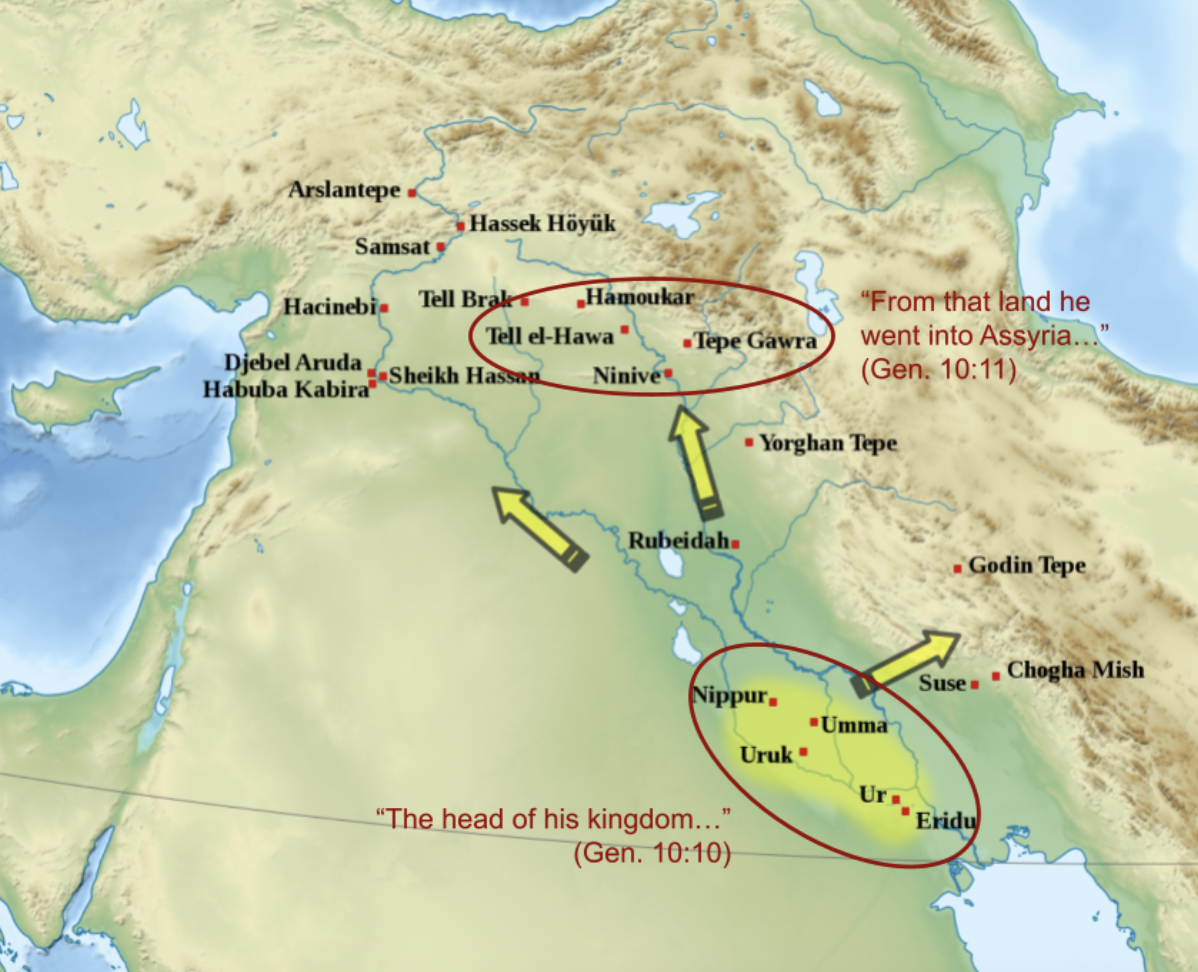
    First of all, we’re told that the beginning or head/center (depending on how Hebrew reshith is interpreted) of his kingdom was in “Shinar” (Sumer), and that the first cities he ruled were “Babel” (Babylon), “Erech” (Uruk), and Akkad. This means that Nimrod, if he existed, is most likely named on the Sumerian King List. [1] His kingdom also extended as far as Nineveh in northern Mesopotamia, which he is said to have built, among other towns. Finally, he was well-known as a hunter in the ancient world.

    There is a king in the Sumerian King List who matches this description. According to the SKL, one of the first kings of Sumer after the Flood was Enmerkar, king of Uruk. The name “Enmerkar” literally means “Enmer the Hunter,” and the consonants of his name (nmr) are almost identical to the original Hebrew consonantal spelling of Nimrod (nmrd), as noted by archeologist David Rohl. [2] Enmerkar was credited as the builder of at least one town(s) as early as the Jemdet Nasr period (ca. 3100 BC), as the “ad-gi4 list” from this time speaks of “Enmerkar… who know[s] how to build towns.” [3] For this reason, his reign is dated to the Late Uruk period (ca. 3400-3200 BC).

    In line with the biblical account, the period of Enmerkar’s reign was one of expansion. The Uruk expansion was first identified in the 1970s, when two sites were discovered in Syria which had significant similarities to the Uruk civilization in Sumer. Uruk-influenced sites or Uruk ‘colonies’ existed in southern Iran, northern Mesopotamia, and even as far northwest as Anatolia. [4] Several hypotheses about this expansion have been advanced, most convincingly, that the Uruk civilization was an informal empire motivated by economic imperialism. [5] Interestingly, a common motif in Late Uruk art and architecture is the ‘hunter-king’ who is at the head of political and religious authority. [6] This evokes the biblical description of Nimrod, king of Erech (Uruk), as a “mighty hunter.”

Figure 1. Adapted from Wikipedia. Map of Uruk expansion overlaid with the regions of the “head” and periphery of Nimrod’s kingdom according to the biblical account.

    The only difficulty in identifying Nimrod with the Late Uruk king Enmerkar is the fact that the biblical author says he ruled “Babel” (Babylon). The city of Babylon didn’t exist until the late 3rd millennium BC, and didn’t become prominent until the time of Hammurabi (mid-2nd millennium BC). It couldn’t have been one of the chief cities of Nimrod’s kingdom. However, the name of Babylon (NUN.KI) in Akkadian cuneiform was also the name of Eridu, a very prominent city which Enmerkar is said to have built in the epic Enmerkar and the Lord of Aratta. [7] One of the religious quarters of Babylon was also called “Eridu.” The 3rd-century BC historian Berossus, in his History of Babylonia, used “Babylon” interchangeably where the Sumerian King List spoke of “Eridu,” showing that the two cities were still conflated at that late date.

    The Tower of Babel (Eridu)

Now we’ve identified Nimrod the hunter-king with Enmerkar, king of Uruk, whose kingdom began with Eridu and Uruk and spread as far as Nineveh. But what about the tower of Babel story itself? Here’s what the Bible states about this event:

Now the whole land had one speech and the same words. And as they migrated from the east, they came upon a plain in the land of Shinar and settled there. And they said to one another, “Come, let us make bricks and fire them thoroughly.” And they had brick for stone and bitumen for mortar. Then they said, “Come, let us build ourselves a city and a tower with its top in the heavens, and let us make a name for ourselves; otherwise we shall be scattered abroad upon the face of the whole land.”

Yahweh came down to see the city and the tower, which mortals had built. And Yahweh said, “Look, they are one people, and they have all one speech, and this is only the beginning of what they will do; nothing that they propose to do will now be impossible for them. Come, let us go down and confuse their speech there, so that they will not understand one another’s speech.” So Yahweh scattered them abroad from there over the face of all the land, and they left off building the city. Therefore it was called Babel, because there Yahweh confused the speech of all the land, and from there Yahweh scattered them abroad over the face of all the land. (Gen. 11:1-9)

Note that Nimrod is nowhere mentioned in this narrative; rather, the focus is on the people of the land. Although it’s possible Nimrod was their king, it’s also possible that they were acting under a different king, no king, or over the span of multiple kings’ reigns.

    As argued above, the “Babel” of the biblical account is most likely Eridu, which had the same name in cuneiform (NUN.KI) as Babylon and could be conflated with that city. Eridu was one of the first settlements in southern Mesopotamia, founded ca. 5400 BC, and was considered the first city in Sumerian mythology, which is consistent with the Bible’s claim that “Babel” was the first city built in “Shinar” (Sumer) after the Flood.

    Eridu was also the site of a major temple to the Sumerian god Enki called E-Abzu (“House of the Aquifer”). The first stratum of this temple (XVII) dates to ca. 5300 BC, shortly after the founding of the city, and the last stratum (I) dates to the Late Uruk period. [8] Interestingly, based on Enmerkar and the Lord of Aratta, the Late Uruk king Enmerkar (whom we have identified with Nimrod) was associated with the building of this temple. After the last period of construction, however, further building suddenly stopped. According to the excavators,

One of the most extraordinary aspects of the terrace-structure associated with Temple I, was the immensel [sic] long time during which it must have remained standing and even in use. For, at least a thousand years after it was built, it had been re-paved with broken bricks, bearing the stamp of a Larsa king. [8]

This puzzling cessation of construction at E-Abzu after the Late Uruk period is a remarkable confirmation of the biblical account of the tower of Babel, which states that the people “left off building the city” after they were scattered by Yahweh!

    Language Confusion

The story of the tower of Babel also purports to explain how the different languages in the ancient Near East came about. Interestingly, the Sumerian epic Enmerkar and the Lord of Aratta makes a similar but opposite statement. In this epic, Enmerkar seeks to obtain rare stones from the land of Aratta in order to build up the E-Abzu temple in Eridu. He tells his messenger to chant the following incantation to the lord of Aratta:

“…may the lands of Cubur and Hamazi, the many-tongued, and Sumer, the great mountain of the decree of magnificence, and Akkad, the land possessing all that is befitting, and the Martu land, resting in security – the whole universe, the well-guarded people – may they all address Enlil [the chief god] together in a single language! …Enki… the lord of Eridu, shall change the speech in their mouth, as many as he had placed there, and so the speech of mankind is truly one.” [7]

Here we see that Enmerkar’s attempt to build the temple of E-Abzu needed all the people of the land to have the same speech, to agree as one in their praise of the gods Enki and Enlil. Changing their speech, as Yahweh did in the biblical account, would foil this attempt.

    However, there was already more than one language in the ancient Near East at this time, as the above quote makes clear. In what sense was “the whole land” of “one speech,” and how did God “confuse their speech” (Gen. 11:1, 7)? The word “speech” (Heb: saphah; LXX: glossa) used here is not the same as the word used to describe the distinct “languages” (Heb: lashon; LXX: cheilos) of the nations (Gen. 10:32). Sapheh typically isn’t used to refer to the language spoken, but to the content of the speech – e.g., righteous or evil, praising or blaspheming. [9] This doesn’t mean that the people all had the same spoken language and it was divided, but that they had unity of purpose in praising the pagan god Enki and building his temple, and God made it so they could no longer agree. This interpretation was held by ancient Jewish and Christian commentators as well. [10]

    Conclusion

Like the rest of the primeval history, the story of Nimrod and the tower of Babel is supported by the sciences, specifically archeology. The existence of Nimrod is confirmed by the evidence for the Late Uruk king Enmerkar – both were known as hunters, town-builders, ruled over a Mesopotamian kingdom from Uruk and Eridu, and had almost identical names. The tower of “Babel” (Eridu) can be identified with the temple of Enki, E-Anzu, which was built continually from ca. 5300 to 3200 BC until construction suddenly stopped. The confusion of speech in Genesis 11 is indirectly corroborated by the Sumerian epic, Enmerkar and the Lord of Aratta. Each of these facts would have been difficult or impossible for an Israelite in the 1st millennium BC to know, so this is evidence for the divine inspiration of the biblical account!


______________________________


[2] David M. Rohl, From Eden to Exile (Lebanon, TN: Greenleaf Press, 2003), 74.

[3] Dina Katz, “Ups and Downs in the Career of Enmerkar, King of Uruk,” in Fortune and misfortune in the Ancient Near East, ed. Olga Drewnowska and Małgorzata Sandowicz (Winona Lake, IN: Eisenbrauns, 2017), 201-2.

[4] Guillermo Algaze, The Uruk World System (Chicago: University of Chicago Press, 1993), 11-97.

[5] Guillermo Algaze, The Uruk World System, 110-127.

[6] Guillermo Algaze, The Uruk World System, 14-15, 41; Michael Roaf, Cultural Atlas of Mesopotamia and the Ancient Near East (Oxford: Andromeda Oxford Ltd., 1996), 71; Guillermo Algaze, “The Prehistory of Imperialism,” in Uruk Mesopotamia and Its Neighbors, ed. Mitchell S. Rothman (Santa Fe, NM: School of American Research Press, 2001), 34; Hans J. Nissen, “Cultural and Political Networks in the Ancient Near East During the Fourth and Third Millennia B.C.,” in Uruk Mesopotamia and its Neighbors, 156-7; Henri Frankfurt, The Cambridge Ancient History 1:2 (New York: Cambridge University Press, 2006), 80.

[7] For the meanings of NUN.KI see https://en.wiktionary.org/wiki/𒉣𒆠#Akkadian; David Rohl, From Eden to Exile, 65; for the epic Enmerkar and the Lord of Aratta, see https://etcsl.orinst.ox.ac.uk/section1/tr1823.htm.

[8] Fuad Safar et al., Eridu (Baghdad, Iraq: Ministry of Culture and Information, 1981), 78-87; the first archeological evidence of baked bricks was also found at Eridu, dating to the Uruk period, which accords with the biblical account (Gen. 11:3), see Kadim H. Hnaihen, “The Appearance of Bricks in Ancient Mesopotamia,” Athens Journal of History 6, no. 1 (2020): 80.

[9] Chris Gousmett, “The confusion of languages,” Evangelical Quarterly 89, no. 1 (2018): 42-46.

[10] Philo, Conf. Ling. 15ff; Jerusalem Targum [Gen. 11:1]; Cyril of Jerusalem, Catechetical Lectures 17.17; Gregory Nazianzen, Orations 41.16.

Primeval History (Genesis 1-11): The Table of Nations


    Throughout this series of posts on the primeval history of the Bible, we’ve seen how the biblical account is not only consistent with but supported by modern science. Based on archeological and paleoclimatological data, the garden of Eden existed in the modern-day Persian Gulf around 10,000 BC. Genetic evidence supports the biblical description of an extremely violent pre-Flood world, peaking in the mid-7th millennium BC. The biblical data can also be used to date Noah’s Flood to ~6,500 BC, the exact time that there is known to have been a massive local flood in the ancient Near East. In this post, we’ll take a look at the account of Noah’s descendants and their spread across the post-Flood world (Gen. 10).

    The Table of Nations

After describing the devastating flood that took place in Noah’s day, the author goes on to give a detailed account of Noah’s descendants and where their lineages lived. Although his wasn’t the only line that survived the Flood, it’s clear that it has a special significance in the biblical account, as he was the ancestor of the Hebrews and the nation of Israel (Gen. 11:10-32). [1] After human civilization in the Near East was devastated, Noah’s descendants spread out across the land and repopulated it.

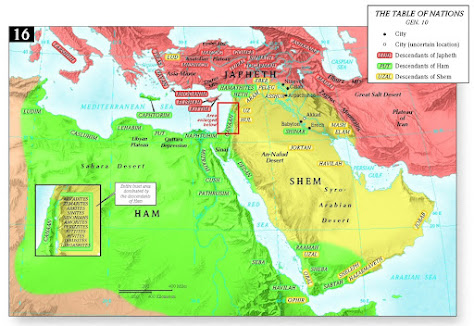
Figure 1. Map of the locations of Noah’s descendants according to the biblical Table of Nations (Genesis 10). Note the lack of representation east of the Zagros mountains, in modern-day Iran.

    However, when viewed in light of the extent of civilization in the ancient Near East, the extent of the Table of Nations is rather selective. No people group east of the Zagros mountains in modern-day Iran is represented, even though Neolithic human civilization existed as far as the Indus Valley. This is even in spite of the fact that Indo-Iranian cultures were in contact with Mesopotamian cultures (see, for example, the legend of Enmerkar and the Lord of Aratta). Why is the Table of Nations selectively describing the spread of human civilization over the Levant, Europe, and North Africa, while ignoring Indo-Iranian cultures?

    The Neolithic Migration

This mystery becomes much less problematic in light of the findings of genetics and archeology, which have identified a migration of Neolithic people from the Levant into Europe and North Africa beginning in the 7th millennium BC. [2] The initial migration of farmers, from eastern Anatolia (modern-day Turkey) into the Aegean, can be dated to after 6,500 BC on archeological grounds. [2] Incidentally, this is the date of the massive flood that was suggested to be Noah’s Flood in my previous post. Neolithic civilization spread slightly later to North Africa, from groups of farmers living in the Levant and Europe. [3] In contrast, the Indo-Iranian Neolithic developed separately from the Levantine-European-North African Neolithic, and forms a distinct genetic grouping. [4]

Figure 2. From Fig. 4 of [4]. There are two distinct genetic groupings separating cultures east and west of the Zagros mountains, which stretch all the way back into the Neolithic.

Thus, once again, the biblical account and modern science support each other! The biblical primeval history, including the Table of Nations, is primarily concerned with the origin of Israel and other Semitic peoples. Therefore, it ignores the origin of Neolithic civilization east of the Zagros mountains, as this was distinct from the spread of civilization in the Levant, Europe, and North Africa.

    Based on the Table of Nations, it appears that Noah’s descendants mixed with the other Neolithic farmers of Anatolia after the Flood, who subsequently spread their culture across Europe and North Africa. This makes even more sense if the “mountains of Ararat” on which Noah’s vessel landed (Gen. 8:4) were in northern Mesopotamia, as usually supposed, rather than in southern Iran (see my previous post for a brief discussion of this). Noah’s lineage would only have been one of many in the ancient Near East, so we wouldn’t expect any specific genetic evidence of his descendants’ spread, but the extent described in Genesis 10 is totally consistent with what we find from genetics and archeology.

    Conclusion

After the account of Noah’s Flood, the biblical author describes the spread of Noah’s descendants across the land. But strangely, no people group east of the Zagros mountains is mentioned in the Table of Nations. This corresponds well to the findings of modern science, that Neolithic culture spread from eastern Anatolia throughout Europe and North Africa after around 6,500 BC, but Indo-Iranian Neolithic culture was genetically and archeologically distinct. This is a remarkable confirmation of the accuracy of the biblical account, once again showing how the Bible and modern science, rather than contradicting, perfectly complement each other!


______________________________

[1] See footnotes 7 and 8 of the previous post. According to the biblical author, the lines of Jabal, Jubal, and the nephilim survived the Flood (Gen. 4:20-22; 6:4; Num. 13:33), which indicates that the universal language of Genesis 7 is hyperbolic (cf. Josh. 10:40).

[2] Mark Lipson et al., “Parallel palaeogenomic transects reveal complex genetic history of early European farmers,” Nature 551 (2017): 368-372; Ayça Omrak et al., “Genomic Evidence Establishes Anatolia as the Source of the European Neolithic Gene Pool,” Current Biology 26 (2016): 270-275.

[3] Luciana G. Simões et al., “Northwest African Neolithic initiated by migrants from Iberia and Levant,” Nature 618 (2023): 550-556.

[4] Farnaz Broushaki et al., “Early Neolithic genomes from the eastern Fertile Crescent,” Science 353, no. 6298 (2016): 499-503.

Primeval History (Genesis 1-11): The Flood of Noah


    So far in this series, we’ve seen how the biblical account of the garden of Eden (Gen. 2-3) and the antediluvian world (Gen. 4-6) are corroborated by science and archeology. But what about the story of Noah’s Flood (Gen. 7-9)? According to many creationists, this was a truly global flood that covered all the land on earth and killed every human and land animal except what was on the ark. But this would leave massive geologic evidence that we simply don’t find, nor do we find evidence of such a severe genetic bottleneck in humans or any animals. Even young-earth creationists, who believe that the Flood laid down much of the geologic column, can’t agree on which layers are from the Flood, because there’s evidence of gradual and/or above-land processes in every layer of the column. [1] Is this a contradiction between the Bible and scientific evidence?

    Kol ha-Eretz, “all the earth” or “all the land”?

One of the key disagreements about the Flood account is the translation and interpretation of the Hebrew phrase, kol ha-eretz. The Hebrew word eretz is ambiguous in English, as it refers to the land (below) as opposed to the sky (above), and can either describe the land of the entire world or a specific region. Many times when kol (“all”) and eretz are found together, it’s modified by the name of a specific land, such as “all the land of Egypt”. [2] In other places, it is both unmodified and universal (referring to the entire earth), which is disproportionately found in poetic passages, and almost always with reference to God’s universal glory or dominion. [3] Most commonly, however, “all the land” is both unmodified and non-universal, referring to a particular area, typically the land of Israel. [4] Finally, there are also a few unclear instances where it could refer to either the entire earth or a specific land. [5]

    The fact that most instances of kol ha-eretz refer to a specific land and not the entire earth strongly supports a non-universal reading of the Flood account. Those who support a universal reading point to several facts that undermine this conclusion.

    First, we are not merely told that “all the land” was covered by water, but that “all the high hills under the whole heaven were covered; the waters surged upward fifteen cubits [23 feet] and covered the hills” (Gen. 7:19-20). According to universal-Flood proponents, this implies that the whole earth was covered. However, this implicitly assumes that the story is being told from a God’s-eye view of the entire globe, which makes no sense from an ancient Hebrew perspective, as they didn’t even know that the globe existed! It’s far more likely that the story is being told from Noah’s view. From the view of someone in southern Mesopotamia or a similar low-lying plain, a massive (but non-universal) flood would make it appear that all the land to the horizon (“under the whole heaven”), including the surrounding hills, were covered by water.

    Second, if the Flood were non-universal, why didn’t the people and animals flee to an unflooded area? This makes another unsupported assumption – that there was time for anyone to flee if the Flood was non-universal. Jesus emphasizes that this disaster was sudden and totally unexpected, so that there was no time for anyone but Noah to prepare, let alone flee (Matt. 24:37-39).

    Third, why did Noah have to build an ark (and not simply flee) if the Flood wasn’t universal? According to the New Testament, the ark prefigures the salvation that comes from Christ, which wouldn’t be as clearly foreshadowed by a mere flight (Matt. 24:36-44; 1 Pet. 3:18-22; 2 Pet. 2:5, 9; 3:5-7). Furthermore, Noah preached to the people around him in a (nevertheless fruitless) attempt to save them, which wouldn’t have been possible if he had fled long before the Flood came (2 Pet. 2:5; Heb. 11:7).

    Fourth, how is it that “all flesh” and “everything… in whose nostrils was the breath of life” died, if the Flood wasn’t universal (Gen. 6:13; 7:21-23)? It’s important to note that in each case, the biblical account qualifies “all flesh” with “upon the land… on the face of the land” (6:11-13; 7:21-23). Thus, only the living things on the land that was flooded must have died. [Again, the ancient Hebrews had no concept of a globe from a ‘God’s-eye view,’ so this is all the land that those on the ark could see.] Even then, however, it’s possible that this is hyperbole. Consider the following passage:

Thus Joshua smote all the land [kol ha-eretz], the mountain country and the Negev and the lowland and the wilderness slopes, and all their kings. He left nothing remaining, but utterly destroyed all that breathed, as Yahweh God of Israel had commanded. (Josh. 10:40)

Here, we’re told that Joshua utterly destroyed all that breathed in all the land, which is strikingly similar to the language used in the Flood account. Yet even later in the same book, we’re also told that the Israelites were unable to drive out many of the Canaanites, and continued to live with them for hundreds of years (Josh. 15:63; 16:10; 17:12f; Judg. 1:19; 3:1-4). This implies that the Genesis Flood account could also be hyperbolic.

    Finally, even though there might be ambiguous biblical support for a universal Flood, there is also clear biblical support for a non-universal Flood. Psalm 104 is a poetic account of creation, which states that when God created the oceans, he “set a boundary that they may not pass, so that they might not again cover the earth” (104:9). This implies that the waters of the Flood couldn’t have covered the whole earth. Furthermore, a few verses indicate that some non-Noahic lines of descent may have survived the Flood (Gen. 4:20f; Num. 13:33). Finally, though it isn’t as conclusive, is the fact that Peter qualifies the extent of the Flood by describing it as “the world of that time” and “the world of the ungodly” (2 Pet 2:5; 3:6).

    A (truly) universal Flood?

Keeping all this in mind, there are nonetheless some indications that the author of the Flood account saw the Noahic Flood as truly universal, which is to say, cosmic in extent. It was seen as the complete undoing (and then re-doing) of the original creation as described in Genesis 1. Consider the following comparison of Genesis 1 with Genesis 7-8:
  1. A wind moves over the face of the waters (Gen. 1:2); a wind passes over the waters (Gen. 8:1)
  2. God separates day from night (Gen. 1:3-5); day and night cease, and are re-created by God after the Flood (Gen. 8:22)
  3. God separates the waters below from the waters above (Gen. 1:6-8); waters below and waters above are mixed and then re-separated (Gen. 7:11; 8:2)
  4. God causes dry land to appear from below the waters, creates plants (Gen. 1:9-13); water covers land and plants die, then land appears and plants re-grow (Gen. 7:10; 8:3, 5, 11)
  5. God sets heavenly bodies to define seasons and days (Gen. 1:14-19); seasons and days cease and are re-created by God after the Flood (Gen. 8:22)
  6. God creates birds to fly above the earth (Gen. 1:20-23); all birds on the land die in the Flood, then birds are released to fly above the earth (Gen. 7:21-23; 8:6-12)
  7. God creates land animals with the breath of life (Gen. 1:24-25); everything with the breath of life in it on the land dies and then is repopulated (Gen. 7:21-23; 8:17, 19)
  8. God creates humans to populate the earth and gives them food (Gen. 1:26-31); all humans on the land die and then are repopulated, and God gives them food (Gen. 7:21-23; 8:16-18; 9:1-4)
  9. God rests on the seventh day (Gen. 2:1-3); God smells the “restful odor” of Noah’s sacrifice after the Flood (Gen. 8:20f)
The re-creation in Gen. 8-9 even appears to happen in the same overall order as the Genesis 1 creation. This suggests that, to the biblical author, the Flood was truly cosmic, undoing the functional order that God had created.

    But does the fact that the Flood was cosmic mean that it was global? Surprisingly, it doesn’t. The destructive power of floods in the ancient world (and the modern world!) meant that cosmic language could be used to describe even local floods. For example, one of the year-names of Ibbi-Sin (a king of Ur in the early 2nd millennium BC) refers to a flood that “obliterated the bounds of heaven and earth.” Yet “no traces of this particular flood were found, presumably because the inevitable mud and sand had been cleared away afterwards.” [6] This shows that it wasn’t unprecedented in the ancient world to use cosmic language to describe a flood – even one so small that it left no trace in the archeological record.

    As argued above, there are indications that the author of the Flood account knew that it wasn’t universal. Gen. 4:20-21 suggests that there were descendants of Cain (through the line of Jabal and Jubal) who still lived at the time that the account was written. [7] Furthermore, Gen. 6:4 and Numbers 13:33, which is attributed to the same author as the Flood account, imply that some of the nephilim survived the Flood. [8] Therefore, even though the author believed the Flood was theologically cosmic in that it overturned God’s functional order, which helps explain the universalistic language, he also knew that it was physically local.

    Identifying Noah’s Flood

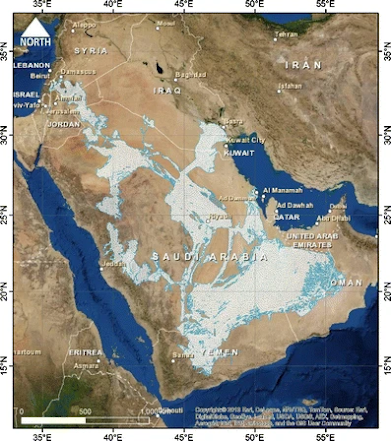
Although the flood of Noah wasn’t a worldwide flood, it still must have been a very, very large flood. After all, God promised never to send a flood that would cause that much devastation to the land again (Gen. 8:21). Such a large deluge should have left at least some evidence. As it happens, there is evidence of a massive flood in the ancient Near East during the time frame suggested by the biblical account! According to Mohammed El Bastawesy, a specialist in hydrology and geomorphology, there is significant evidence that a huge paleolake which existed in modern-day Saudi Arabia breached its boundaries ~8500 years ago (~6500 BC), causing extensive flooding. [9]

Figure 1. From Fig. 7 of [9]. The extent of the flood path as a paleolake breached the Tuwaiq escarpment in modern-day Saudi Arabia, approx. 6500 BC.

    Lorence Collins, a Christian geologist, argues that this deluge would have extended into the Mesopotamian basin as it drained into the Persian Gulf, as far north as the hill country of Urartu, making it a prime contender for Noah’s Flood. [10] Even if Collins’ estimate is exaggerated, this is by far the largest flood in the ancient Near East within the time frame required by the biblical account. Furthermore, while “Ararat” in the biblical account may indeed refer to Urartu in northern Mesopotamia as traditionally believed, it could also refer to Aratta, the land in Sumerian mythology which lay beyond the mountains of modern-day southern Iran. A local flood in Arabia and the Mesopotamian basin would have drained into the Persian Gulf, making the mountains of southern Iran the most likely location for the resting place of Noah’s boat.

    The biblical description of Noah’s ark can also be used to provide an approximate earliest possible date for the Flood, as it says that bitumen was used to build the raft. The first use of bitumen as a waterproofing and building material in the ancient Near East is dated to ~7200-6800 BC. [11] Furthermore, according to the account of Cain’s descendants, the pre-Flood man Jabal was the ancestor of nomadic pastoralists (“those who live in tents and raise livestock”), and the rise of nomadic pastoralism in the Near East has been dated to the seventh millennium BC. [12] Finally, based on the level of Y-chromosome diversity, it has been found that there was a period of severe warfare resulting in the death of many bloodlines, which peaked around ~8,300 years ago (~6,300 BC) in the Near East. [13] As discussed in the last post, this is reminiscent of the biblical description of extreme violence in the pre-Flood world (Gen. 6:11). All of this points to a mid-7th millennium BC date for Noah’s Flood, perfectly matching the Arabian deluge that happened ~6,500 BC!

    Noah’s Ark

Noah’s flood may be convincingly identified with the Arabian deluge of ~6500 BC, but what about Noah’s ark? The dimensions given in the biblical account (300 x 50 x 30 cubits = 450 x 75 x 45 feet) are far too large to describe a seaworthy wooden vessel. The largest wooden boat ever built, the Wyoming, was 450 x 50 x 30 feet, requiring pumps to stay afloat, and eventually sank due to the stress on its hull. If Noah’s boat were a wooden vessel, the dimensions in the biblical account would be physically impossible. This leaves two possibilities: either Noah’s ship wasn’t a wooden vessel, or the dimensions given in the biblical account are hyperbolic (or both).

    An important clue as to the structure of Noah’s vessel can be found in other ancient Near Eastern flood myths. According to the Sumerian and Babylonian flood myths (the Epics of Atrahasis and Gilgamesh, respectively), the flood hero was instructed to dismantle his house (a reed hut) and use it to build a boat. The Ark Tablet states that the boat was 120 by 120 cubits (14,400 cu^2), which is nearly the same surface area as the biblical dimensions (15,000 cu^2). These descriptions, along with the biblical description of the ark, are entirely consistent with that of a mudhif (reed hut) atop a giant reed raft. [14] Unlike a wooden boat of massive dimensions, this would have been seaworthy, and is compatible with the level of technological development at the time of the Flood.

    As for the animals on the ark, analysis of rock carvings from Shuwaymis, Saudi Arabia, near the origin point of the Arabian deluge, shows that only 16 animal species were represented. [15] This suggests that there were few animal species recognized by humans in this area at the time, so it wouldn’t have been necessary to take thousands, let alone millions, of animals on the ark as some skeptics have claimed.

    Conclusion

We’ve already seen how the biblical account of the garden of Eden (Gen. 2-3) and the pre-Flood world (Gen. 4-6) is completely consistent with and supported by modern science. As it turns out, this is also true of the account of Noah’s Flood. Contrary to what young-earth creationists believe and argue, the Flood wasn’t a worldwide event but a local one, although it had theologically cosmic implications to the author of the account. In fact, several people groups survived the Flood according to the biblical record (Gen. 4:20-22; 6:4; Num. 13:33). Based on the known dates of the rise of nomadic pastoralism (Gen. 4:20), the first use of bitumen (Gen. 6:12), and a period of extreme warfare in the ancient Near East (Gen. 6:11), we can pinpoint the date of the Flood to the mid-7th millennium BC. As it happens, there was in fact an extreme flood at this time (~6,500 BC), larger than any that have occurred in the area since! Therefore, just as in its earlier portions, the biblical primeval history and modern science once again support each other.


______________________________

[1] Phil Senter, “The Defeat of Flood Geology by Flood Geology,” Reports of the National Center for Science Education 31, no. 3 (2011): 3-16.

[2] Modified: Gen. 2:11, 13; 17:8; 41:19, 29, 41, 43, 44, 46, 54, 55; 45:8, 20, 26; Exod. 5:12; 7:19, 21; 8:16, 17, 24; 9:9, 22, 24, 25; 10:14, 15, 22; 11:6; Josh. 1:4; 10:41; 11:16; 13:4; 24:3; Judg. 11:21; 1 Sam. 13:19; 1 Kgs. 4:10; 15:20; 2 Kgs. 10:33; 15:29; 1 Chron. 13:2; 2 Chron. 11:23; 15:8; 34:7; Jer. 44:26.

[3] Not modified, universal: Gen. 1:26, 29; 18:25; 9:14, 16; 19:5; Exod. 34:10; Num. 14:21; Josh. 3:11, 13; 23:14; 1 Sam. 17:46; 1 Kgs. 2:2; 2 Kgs. 5:15; 2 Chron. 16:9; Psa. 8:1, 9; 19:4; 45:16; 47:2, 7; 57:5, 11; 66:1; 72:19; 83:18; 96:1, 9; 97:5, 9; 98:4; 100:1; 105:7; 108:5; Isa. 6:3; 12:5; 14:26; 25:8; 54:5; Mic. 4:13; Zech. 4:14.

[4] Not modified, not universal: Gen. 13:9, 15; 19:28; 26:3, 4; 41:54, 57; 47:13; Exod. 32:13; Num. 21:26; Deut. 11:3, 25; 19:8; 28:52; 29:2, 23; 34:1, 11; Josh. 2:3, 24; 6:27; 9:24; 10:40; 11:16, 23; 21:43; Judg. 6:37, 39, 40; 1 Sam. 13:3; 30:16; 2 Sam. 15:23; 18:8; 24:8; 1 Kgs. 9:19; 10:24; 2 Kgs. 17:5; 19:11; 1 Chron. 14:17; 22:5; 2 Chron. 8:6; 34:33; Isa. 7:24; 10:23; 13:5; 28:22; 37:11, 18; Jer. 1:18; 4:20, 27; 8:16; 12:11; 15:10; 16:15; 23:3, 8, 15; 25:11; 27:6; 32:37; 50:23; 51:7, 25, 28, 41, 47, 49, 52; Ezek. 22:4; 32:4; 35:14; 36:24; Dan. 9:7; Zech. 13:8; 14:9, 10.

[5] Unclear: Gen. 9:19; 11:1, 4, 8, 9; 1 Chron. 16:14, 23, 30; Job 42:15; Psa. 33:8; 48:2; Isa. 10:14; 14:7; Jer. 40:4; Lam. 2:15; Ezek. 20:6; Dan. 8:5; Hab. 2:20; Zeph. 1:18; 3:8, 19; Zech. 1:11; 4:10; 5:3, 6; 6:5.

[6] M. E. L. Mallowan, “Noah’s Flood Reconsidered,” Iraq 26, no. 2 (1964): 66.

[7] Jabal, a descendant of Cain, is said to be the “father of those who live in tents and raise livestock,” while his brother Jubal is said to be the “father of all who play the kinnor [string instrument] and ugab [wind instrument].” This implies that the author believed Jabal and Jubal’s lines were still alive in his day.

[8] The nephilim are said to be the children of the “sons of God” and “daughters of men,” yet according to the ancient Jewish tradition which was carried over into the New Testament, these “sons of God” were imprisoned (2 Pet. 2:4f; Jude 6), so the post-Flood nephilim can’t be the result of new mating between angels and humans. Furthermore, Gen. 6:4 explicitly says that the same group of nephilim were “in the land” both “in those days, and also afterward.”

[9] Mohammed El Bastawesy, “The geomorphological and hydrogeological evidences for a Holocene deluge in Arabia,” Arabian Journal of Geosciences 8 (2015): 2577-2586; this corresponds to a period of an intensely wet climate in the Near East which has not yet been repeated, see Alan Dickin, “New Historical and Geological Constraints on the Date of Noah’s Flood,” Perspectives on Science and Christian Faith 70, no. 3 (2018): 181-183.

[10] Lorence G. Collins, A Christian Geologist Explains Why the Earth Cannot Be 6,000 Years Old (Pittsburgh, PA: Dorrance Publishing Co., 2021), 86-7.

[11] Michael W. Gregg et al., “Bitumen in Neolithic Iran: Biomolecular and Isotopic Evidence,” in Archaeological Chemistry, ed. M. D. Glascock, R. J. Speakman, and R. S. Popelka-Filcoff (Washington DC: American Chemical Society, 2007), 137-151.

[12] Benjamin S. Arbuckle and Emily L. Hammer, “The Rise of Pastoralism in the Ancient Near East,” Journal of Archaeological Research 27 (2019): 391-449.

[13] Monika Karmin et al., “A recent bottleneck of Y chromosome diversity coincides with a global change in culture,” Genome Research 25, no. 4 (2015): 459-466; see Supplemental Table S4 for the date of the most extreme bottleneck in the Near East (8.3 kya).

[14] Alan Dickin, “The Design of Noah’s Ark and Its Significance for Biblical Faith,” Perspectives on Science and Christian Faith 74, no. 2 (2022): 97-104.

[15] Maria Guagnin et al., “Rock art imagery as a proxy for Holocene environmental change: A view from Shuwaymis, NW Saudi Arabia,” The Holocene 26, no. 11 (2016): 1822-1834.

Primeval History (Genesis 1-11): The Antediluvian World


    In the last post, we looked at the biblical account of the garden of Eden (Gen. 2-3) and saw that every single detail matches the history of the Persian Gulf oasis about 12,000 years ago. Many scientific fields from archeology to paleoclimatology to 14C dating come together to support the biblical story. Therefore, contrary to anti-scientific readings of Genesis like young-earth creationism, the Bible and modern science actually corroborate each another. Here we’ll examine the biblical account of the world before the Flood, described in Genesis 4-6, to see if it matches with what we know from science.

    Cain and Abel

After Adam and Eve are expelled from the garden of Eden for sinning, and face the punishments of patriarchy and agriculture (Gen. 3:16-19), we’re next told about their children Cain and Abel. Abel is said to be a sheepherder, and Cain is a crop grower (4:2). Based on the archeology and paleoclimatology of the Persian Gulf basin, we’re able to date Adam and Eve’s expulsion to approximately 10,000 BC. [1] Based on 14C dating of archaeological finds, the introduction of agriculture in the Near East can be dated to ~10,000 BC, while the domestication of sheep became widespread before ~8,500 BC based on Y-chromosome clocks. [2] This fits the timeline of the biblical account.

    More interesting is the account of Cain’s curse after he murdered his brother Abel. God punishes Cain by making him unable to till the soil and forcing him to wander the land for the rest of his life.

Cain said to Yahweh, “My punishment is more than I can bear! Today you have driven me away from the soil, and I shall be hidden from your face; I shall be a fugitive and wanderer on the earth, and anyone who meets me will kill me.”

Then Yahweh said to him, “Not so! Whoever kills Cain will suffer a sevenfold vengeance.” And Yahweh put a mark on Cain, so that no one who came upon him would kill him.

Then Cain went away from the presence of Yahweh and settled in the land of Nod, east of Eden. Cain knew his wife, and she conceived and bore Enoch, and he built a city and named it after his son Enoch. (Gen. 4:13-17)

This is only one generation from Adam, and we’re only told of one other child that he had apart from Cain and Abel (Gen. 5:3). So who are the unnamed people that Cain is worried will kill him? And where did he find his wife? And how are there enough people east of Eden for him to build a settlement with? [3]

    This entire passage strongly suggests the existence of other people outside the garden of Eden; it's not conclusive, as a just-so story could be concocted about Adam and Eve having hundreds of children before Cain is expelled, but it's certainly compelling. Although the Bible doesn’t explicitly say that other humans lived before Adam and Eve, nor does it explicitly contradict this possibility. [4] The earliest fossils of Homo sapiens have been found in the Jebel Irhoud cave in Morocco, and two independent dating methods (thermoluminescence and electron spin resonance) arrive at a date of ~300,000 years before present for these fossils. [5] Thus, even if we assume that other species of Homo weren’t ‘true humans’ by the biblical definition, as some old-earth creationists have claimed, humans existed hundreds of thousands of years before Adam and Eve. This is supported biblically by the Cain narrative, which places other humans in “the land of Nod, east of Eden,” at the same time as Adam and Eve.

    Symbolic Ages of Patriarchs?

Following the account of Cain’s curse and his descendants, we’re given a genealogy from Abel’s son Seth to the patriarch Noah (Gen. 5). Unlike other genealogies in the Bible, this one gives the ages of the patriarchs at the time that their children were born and when they died. However, the patriarchs’ ages when their children were born (65-187 yo) and when they died (777-969 yo) are extremely high! From the skeletons of humans during this period, especially the wear of the teeth, we can tell that the average age at death was between 20 and 30 years old. [6] So how can we explain these high ages?

    First, it’s possible that the patriarchs really did live this long because God kept them alive. Science can’t discount the possibility of miracles. However, this is scripturally difficult because there’s no indication of any miracles in the passage itself. There are other biblical reasons to doubt the literality of these old ages as well. For one, Abraham is said to have died at “a good old age… full of years” at 175 yo (Gen. 25:8), but if the ages are literal, then he lived alongside all of his much more long-lived ancestors all the way back to Noah. In fact, three of his ancestors, Shem, Shelah, and Eber, would have outlived him!

    Furthermore, all of the thirty numbers in Genesis 5 end in significant numbers: 0, 5 (60 months), 7 (number of perfection), 2 (5 + 7 = 12), and 9 (5 + 7 + 7 = 19). Although these numbers may not seem significant in our culture, it’s as though every age ended in an even number, for example. The chance of this occurring randomly is less than 1 in 1 billion. [7] This indicates that the numbers had symbolic meaning and shouldn’t be interpreted literally. None of the ages in Genesis 11 end in 1 or 6, which isn’t quite as significant, but still comes out to a ~1 in 650,000 chance. [7]

    In fact, in almost every ancient Near Eastern culture, the ‘patriarchs’ of the culture were given artificially elongated lifespans with symbolic value as a sign of respect. For example, the Sumerian King List and Turin King List (Egypt) begin with reign lengths in the thousands of years and slowly decrease from there. Many of these are known to have been real kings from the archeological record, such as Enmerkar and Gilgamesh, but they didn’t have reigns in the hundreds of years. In Egypt, “he died aged 110” was actually an epitaph for someone considered outstandingly selfless, not meant as a literal age. [8] Significantly, this is said to have been Joseph and Joshua’s age at death (Gen. 50:26; Josh. 24:29), and their lives marked the beginning and end of the Egyptian exile.

    Thus, it’s most likely that the ages given in Genesis 5 and 11, and other extreme ages throughout the early part of the Old Testament, were symbolic in a way that was accepted in the ancient Near East as a way to venerate one’s ancestors. If the ages of the patriarchs were symbolic, this also raises the possibility that the Genesis genealogies contain significant gaps, as many other genealogies throughout the Bible do. [9] This explains how Adam and Eve could have lived as long ago as 10,000 BC, even though a literal reading of the Genesis genealogies would place their creation around ~4,000 BC.

    Pre-Flood Wickedness

Before the Flood, the world is said to have been an extremely violent and evil place. According to Genesis 6:5, “the wickedness of humans was great in the land and… every inclination of the thoughts of their hearts was only evil continually.” The reason that the Flood was sent is because “the land was corrupt in God’s sight, and the land was filled with violence” (Gen. 6:11). A group of people called nephilim, who are said to have been the offspring of the “sons of God” and “daughters of Adam,” were “the heroes of old, warriors of renown” (Gen. 6:4), much like the demigods of other mythologies.

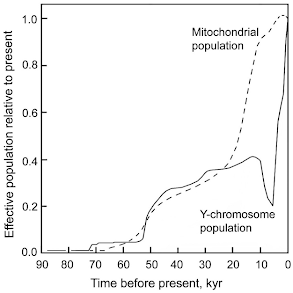
    As it happens, there’s actually genetic evidence of this period of extreme violence! Based on an analysis of Y-chromosome diversity among modern humans, we can tell that there was a severe bottleneck among men (but not among women) beginning about 10,000 years ago. [10] In the ancient Near East, which is “the land” under consideration in the biblical account, the bottleneck was most extreme about 8,300 years ago, after which the male population began to recover. [10]

Figure 1. Adapted from Fig. 2 of [10]. There was a severe bottleneck among the effective male population (Y-chromosome population) beginning about 10,000 years ago, which is not seen in the effective female population (mitochondrial population).

    Thanks to computer modeling, we now know that the most likely cause of this bottleneck is extreme warfare between patrilineal clans (descended from one man). [11] When a patrilineal clan is wiped out by warfare, the unique Y-chromosome signature from their common (male) ancestor is lost, while the mitochondrial DNA diversity is retained by intermarriage of women between clans. This violence and warfare is reflected in the biblical account (and, interestingly, not in other ancient Near Eastern flood myths).

    Conclusion

The biblical account of the pre-Flood world (Gen. 4-6) includes the story of Cain and Abel as well as the genealogy of Noah. Although they contain no specific details that can be corroborated by science, nor do they contradict the scientific data. The narrative of Cain’s curse strongly suggests the existence of other people outside the garden of Eden, supporting the findings of science that Homo sapiens has existed since at least 300,000 years ago. The record of extreme violence and wickedness is supported by evidence of a Y-chromosome bottleneck in the Near East around 6,300 BC. Thus, as we saw earlier with the description of the garden of Eden in Genesis 2-3, the biblical account of the pre-Flood world and the findings of modern science corroborate each other.


______________________________

[1] Jeffrey I. Rose, “New Light on Human Prehistory in the Arabo-Persian Gulf Oasis,” Current Anthropology 51, no. 6 (2010): 849-883.

[2] Dorian Q. Fuller, “Contrasting Patterns in Crop Domestication and Domestication Rates: Recent Archaeobotanical Insights from the Old World,” Annals of Botany 100, no. 5 (2007): 903-924; Juan Deng et al., “Paternal Origins and Migratory Episodes of Domestic Sheep,” Current Biology 30 (2020): 4085-4095.

[3] Interestingly, there existed several settlements along the eastern Persian Gulf dating to around this time period (~10,000 BC), which “hints at a population around the eastern Gulf basin and associated tributaries distinct from its northern Zarzian neighbors carrying out some form of intensive plant processing” [1, p. 863]. Note however that “land of Nod” literally means “land of wandering” and may not refer to a specific place.

[4] Note that the Bible never claims Adam and Eve were the first or only humans that existed at the time, contrary to popular belief. All it claims is that Eve was the (genealogical) “mother of all living” at the time Genesis 3:20 was written, without precluding the existence of other ancestors. Paul refers to Adam as the “first man,” but in the same passage refers to Jesus as the “second man,” indicating that he is speaking of the first and second archetypal “man,” not the literal first and second humans (Jesus wasn’t the second human to exist!). For further discussion see Joshua Swamidass, The Genealogical Adam and Eve (Westmont, IL: InterVarsity Press, 2019).

[5] Daniel Richter et al., “The age of the hominin fossils from Jebel Irhoud, Morocco, and the origins of the Middle Stone Age,” Nature 546 (2017): 293-296.

[6] For example, see Jean-Pierre Bocquet-Appel and Jean Noel Bacro, “Brief communication: Estimates of some demographic parameters in a neolithic rock chamber (approximately 2000 BC) using iterative techniques for aging and demographic estimators,” American Journal of Biological Anthropology 102, no. 4 (1997): 569-575.

[7] Carol A. Hill, “Making Sense of the Numbers in Genesis,” Perspectives on Science and Christian Faith 55, no. 4 (2003): 243-245.

[8] R. K. Harrison, “Reinvestigating the Antediluvian Sumerian King List,” Journal of the Evangelical Theological Seminary 36, no. 1 (1993): 4; consider the epitaph of Imhotep, a scribe during the 3rd Dynasty of Egypt.

[9] John Millam, “The Genesis Genealogies,” Reasons to Believe, June 2010, https://reasons.org/explore/publications/articles/the-genesis-genealogies.

[10] Monika Karmin et al., “A recent bottleneck of Y chromosome diversity coincides with a global change in culture,” Genome Research 25, no. 4 (2015): 459-466; see Supplemental Table S4 for the date of the most extreme bottleneck in the Near East (8.3 kya).

[11] Tian Chen Zeng et al., “Cultural hitchhiking and competition between patrilineal kin groups explain the post-Neolithic Y-chromosome bottleneck,” Nature Communications 9 (2018): 2077.

Primeval History (Genesis 1-11): The Garden of Eden

    The “primeval history” in the Old Testament (Gen. 1-11) is the source of a lot of debate and contention among Christians. Many Christians understand these chapters to be entirely allegorical because of their apparent discordance with the findings of modern science, and their similarity to other ancient myths. Some take the primeval history to be a mixture of allegory and true history. Others try to fit together a literal understanding of this history with the findings of modern science. Finally, a minority of Christians – who, like the first group, see a discordance between the Bible and science – simply reject the findings of modern science altogether in favor of a hyper-literalistic reading of Genesis 1-11, arguing that the universe is only 6,000 years old, and there was a global flood about 4,500 years ago.

    Although I agree that the scientific data are inconsistent with the hyper-literalistic reading of Genesis 1-11 supported by young-earth creationists, I don’t abandon either modern science or the Biblical account. In this series of posts, I will argue for a concordist interpretation of the primeval history which agrees with both God’s word and the evidence we find in God’s creation, beginning with identifying the Garden of Eden (Gen. 2-3) with a real, historical location that existed about 12,000 years ago. [We’ll skip over the creation account in Genesis 1 for now because there are so many interpretations of this chapter; maybe we’ll come back to it later.]

    Biblical Description of the Garden of Eden

The garden of Eden is described in the primeval history as follows:

When no plant of the field was yet in the land, and no vegetation of the field had sprung up – for Yahweh God had not yet caused it to rain upon the land, and there was no one to till the ground, but a spring would come up from the land and water the whole face of the ground – then Yahweh God formed the man [ha-Adam] from the dust of the ground and breathed into his nostrils the breath of life, and the man became a living soul. And Yahweh God planted a garden in Eden, in the east, and there He put the man whom He had formed. Out of the ground Yahweh God made to grow every tree that is pleasant to the sight and good for food, the tree of life also in the midst of the garden, and the tree of the knowledge of good and evil.

A river rises in Eden to water the garden, and from there it divides and becomes four headwaters. The name of the first is Pishon; it is the one that flows around the whole land of Havilah, where there is gold, and the gold of that land is good; bdellium and onyx stone are there. The name of the second river is Gihon; it is the one that flows around the whole land of Kush. The name of the third river is Tigris, which flows east of Assyria. And the fourth river is Euphrates. (Genesis 2:6-14)

    Based on the very detailed description of the rivers in vv. 10-14, the author wants his audience to be able to identify the garden of Eden at a specific location. The problem with this, however, is one that most residents of the ancient Near East should have been aware of. The Tigris and Euphrates don’t come from the same river, but instead diverge north of the Assyrian heartland and originate at two different places in modern-day eastern Turkey, contrary to what verse 14 says! There are thus two possibilities: the author of Genesis 2-3 purposely referenced a geographic impossibility to indicate to his audience that the garden of Eden was a mythical location, or the direction of the rivers has been reversed for thematic purposes (as the Tigris and Euphrates do meet downstream in the south).

    If the second possibility is correct, the rivers are being described as though the reader is standing in Eden and looking upstream toward the sources of the four rivers, as a thematic device. This interpretation is supported by E. A. Speiser, a Jewish commentator and scholar of the ancient Near East. [1] Under the assumption that the garden of Eden wasn’t a mythical place, what other details can we determine from the biblical account?
  1. The garden was east of Israel (Gen. 2:8)
  2. The garden existed at the confluence of four rivers, including the Tigris and Euphrates (Gen. 2:10)
  3. The first river encircled Havilah, a land rich with gold, bdellium, and onyx stone (Gen. 2:11f)
  4. The second river encircled the land of Kush (Gen 2:13)
  5. The land of Eden had no rain, but was well-watered by a spring (Gen 2:5f)
  6. No people lived there to till the ground (Gen 2:5)
  7. This account took place just before, or concurrent with, the beginning of agriculture and gender hierarchies as part of Adam and Eve’s curse (Gen 3:16-19)
  8. The garden is no longer accessible to humans (Gen 3:22-24)
If the biblical account of the garden of Eden describes a real and not just mythical location, then we should be able to find a place that satisfies all these criteria. Finding out that Genesis 2-3 accurately describes something this far in the past would also be a boost to the literal interpretation of the primeval history, and the accuracy of the Bible in general. So what do we see?

    The Persian Gulf Oasis

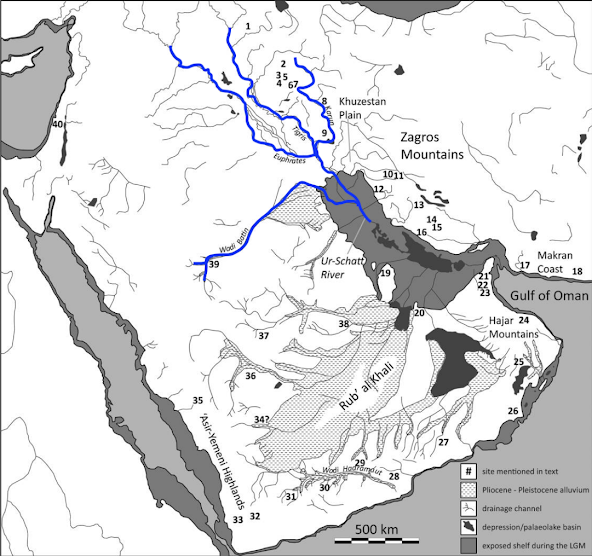
In fact, there is a location that perfectly matches the biblical description of the garden of Eden! At the confluence of the Tigris, Euphrates, and Karun rivers, as well as another river which has since dried up (Wadi al-Batin), there was once an oasis. These four rivers came together to form another river, the Ur-Schatt, in what is now the Persian Gulf. Wadi al-Batin can be identified with the Pishon, as it encircles Havilah (recognized by most commentators to be a location in Arabia), and its location of origin was a gold mine in ancient times (the Mahd adh Dhahab). Some commentators and translators also identify “Kush” in Genesis 2:13 with the homeland of the Kassites in modern-day Iran, which would make it possible to identify the Karun River with the Gihon. [2]

Figure 1. Adapted from Fig. 2 of [3]. The four rivers (Wadi Batin, Karun, Tigris, Euphrates) which drain into the Ur-Schatt River, proposed to be the river that watered the garden of Eden, are highlighted in blue.

    This region, now covered by the Persian Gulf, was exposed land during the last ice age when sea levels were much lower. Although it went through a hyper-arid period with a severe lack of rain from about 24,000 to 12,000 years ago, the Ur-Schatt River continued to flow, and the oasis was well-watered by freshwater springs known as khawakb. [3] During this period, archeological sites around the Gulf disappear, indicating that humans no longer lived there. [3] The oasis was covered by the Persian Gulf from 12,000 to 11,000 years ago as the ice age ended and sea levels rose, making it inaccessible to humans. [3,4] Archeological evidence places the origin of agriculture in the ancient Near East around the same time, and this is speculated to be accompanied by the loss of gender equality associated with hunter-gatherer bands. [5]

    Thus, every single aspect of the account in Genesis 2-3 seems to be corroborated by the archeological evidence from the Persian Gulf:
  1. The oasis was east of Israel (cf. Gen. 2:8)
  2. The oasis existed at the confluence of four rivers, the Tigris, Euphrates, Karun, and Wadi Batin (cf. Gen. 2:10-14)
  3. The Wadi Batin [Pishon] encircled Arabia [Havilah], a land rich with gold, bdellium, and onyx stone (cf. Gen. 2:11f)
  4. The Karun [Gihon] encircled the Kassite homeland [Kush] (cf. Gen. 2:13)
  5. The oasis was hyper-arid [had no rain], but was well-watered by freshwater springs [khawakb] (cf. Gen. 2:5f)
  6. No people lived there at the time because it had been abandoned (cf. Gen. 2:5)
  7. This all took place just before the introduction of agriculture and gender hierarchies in the ancient Near East [part of Adam and Eve’s curse] (cf. Gen. 3:16-19)
  8. The oasis is no longer accessible as it is under the Persian Gulf (cf. Gen. 3:22-24)
This is a remarkable confirmation of the biblical description of the garden of Eden and the story of Adam and Eve!

    Other Ancient Descriptions of Eden

Genesis 2-3 isn’t the only account of a legendary garden in the Persian Gulf. The same motif can actually be found in several Mesopotamian creation myths, where it’s called “Dilmun.” In the Sumerian creation myth (Eridu Genesis), Dilmun is the land of immortality, called “the place where the sun rises” and “the land of the living.” In the Sumerian myth Enki and Ninhursag, Dilmun is called “the pure clean and bright land of the living, the garden of the great gods and earthly paradise.” Enki, the creation god, promises to the earth god Ninhursag,

For Dilmun, the land of my lady's heart, I will create long waterways, rivers and canals, whereby water will flow to quench the thirst of all beings and bring abundance to all that lives.

In the Babylonian creation myth Enuma Elish, the location of creation is said to be where the saltwater and freshwater “were mingled together.” Dilmun, the legendary land of creation, is now known to have been a real kingdom located on the island of Bahrain in the Persian Gulf, where freshwater springs mix with the saltwater of the gulf.

    Both the Genesis account and Mesopotamian myths record the existence of an oasis in the Persian Gulf in the legendary past. They include similar details as well, for example, both describing the oasis as being “in the east” (or “where the sun rises”) and the existence of the freshwater springs (khawakb). However, the Genesis account contains far more detail and is also more accurate, describing the existence of the Ur-Schatt River and the lack of rain and human occupation. This means that Genesis 2-3 didn’t merely borrow from Mesopotamian myths; it must have had its own source for these details, which weren’t preserved in any other account. I see this as strong evidence for the divine inspiration of the primeval history.

    Implications

The fact that the biblical description of the garden of Eden matches the Persian Gulf oasis so well isn’t just good evidence for the accuracy of the Bible, it also has other implications for the interpretation of the primeval history. For one, underneath the present Persian Gulf, there is a full geologic column stretching back to the Cambrian age. [6] All of this must have been laid down long before the garden of Eden and Adam and Eve were created. Therefore, the young-earth creationist belief that Noah’s Flood laid down the sedimentary rock record must be false.

    Furthermore, multiple dating methods were used to pinpoint the date of the Persian Gulf oasis, including radiocarbon dating, varve counting, and using stone artifacts for relative dating. [3] All these methods, along with the methods of paleoclimatology, corroborate one another and the biblical account, placing all the elements of the story of Adam and Eve some 12,000 years ago. For the account of the garden of Eden to be correct, all these dating methods must also be correct – indeed, the biblical account (if accurate) almost demands it. The earth and human civilization must be older than 6,000 years old, further refuting both the young-earth and gap-theory interpretations of the primeval history. [7]

    Finally, this has intriguing implications for the existence of humans outside of the garden of Eden. Humans existed long before 12,000 years ago (anatomically modern Homo sapiens date back to >200 kya), and there were even humans in the Persian Gulf before it was abandoned around 24,000 years ago. This means that there were other humans who populated the earth before Adam and Eve were created. The Genesis account is silent on the issue of whether humans existed outside of the garden, although there are some hints that they did (Gen. 4:13-17), which I’ll discuss more in the next post. [8]

    Conclusion

The biblical account of the garden of Eden (Gen. 2-3) includes eight specific details that can be used to pinpoint its location in history. If we examine the archeological record with this in mind, we find that all the details are exactly corroborated by the evidence for a Persian Gulf oasis that was lost to the sea about 12,000 years ago (10,000 BC). This is strong evidence for the accuracy of a literal interpretation of the primeval history (Gen. 1-11). We find that the biblical account and modern science corroborate each other, which refutes anti-scientific, hyper-literalistic readings of Genesis. In the next post, we’ll take a look at the biblical account of the antediluvian world (Gen. 4-6) to see whether this is also corroborated by the scientific data.


______________________________

[1] E. A. Speiser, The Anchor Bible Genesis: Introduction, translation and notes (New York: Doubleday, 1964), 16-17.

[2] See for example Brown, Driver, and Briggs, A Hebrew and English Lexicon of the Old Testament (Oxford: Clarendon Press, 1980), 429; this is supported by the use of “Kush” in Gen. 10:8 and 1 Chron. 1:10, which most commentators and ANE scholars understand to refer to the Kassites, as the other “Kush” (modern-day Ethiopia) is far from Mesopotamia.

[3] Jeffrey I. Rose, “New Light on Human Prehistory in the Arabo-Persian Gulf Oasis,” Current Anthropology 51, no. 6 (2010): 862-3.

[4] Kurt Lambeck, “Shoreline reconstructions for the Persian Gulf since the last glacial maximum,” Earth and Planetary Science Letters 142 (1996): 43-57; Gholamreza Hosseinyar et al., “Holocene sea-level changes of the Persian Gulf,” Quaternary International 571 (2021): 26-45.

[5] Dorian Q. Fuller, “Contrasting Patterns in Crop Domestication and Domestication Rates: Recent Archaeobotanical Insights from the Old World,” Annals of Botany 100, no. 5 (2007): 903-924; M. Dyble et al., “Sex equality can explain the unique social structure of hunter-gatherer bands,” Science 348, no. 6236 (2015): 796-798.

[6] Fereydoun Ghazban, Petroleum Geology of the Persian Gulf (University of Tehran, 2007).

[7] The gap-theory interpretation is more in line with modern science, but it still requires a clean break in the archeological record of human civilization about 6,000 years ago when God supposedly ‘reset’ creation. If our dating methods aren’t somehow severely distorted, we simply don’t find any such break going back hundreds of thousands of years.

[8] Note that the Bible never claims Adam and Eve were the first or only humans that existed at the time, contrary to popular belief. All it claims is that Eve was the (genealogical) “mother of all living” at the time Genesis 3:20 was written, without precluding the existence of other ancestors. Paul refers to Adam as the “first man,” but in the same passage refers to Jesus as the “second man,” indicating that he is speaking of the first and second archetypal “man,” not the literal first and second humans (Jesus wasn’t the second human to exist!). For further discussion see Joshua Swamidass, The Genealogical Adam and Eve (Westmont, IL: InterVarsity Press, 2019).

Done blogging – vet school!

Tomorrow I start veterinary school at Purdue! I don't anticipate that I'll be blogging anymore, at least for the foreseeable future....